
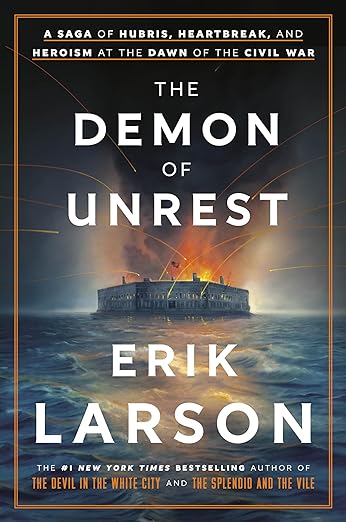
I enjoyed this book. Larson’s narrative style is captivating, introducing characters and events in a way that builds tension and excitement. The alternating perspectives keep the reader engaged, making for a thrilling read while also offering historical education.
The topic here is not just about the famous Battle at Fort Sumter. Larson shows us how Fort Sumter became the flashpoint of years of clashing societal norms, economic forces, and politics. We get a glimpse of Southern society with a facade of honor and chivalry, but the ugly elephant in the room is slavery. Some held the view that the black race was inferior and that God destined them to forced servitude. Others may not have been fully supportive of it and found it cruel; nonetheless, it was just the way things were and had always been, and they went on with it in their lives. But for most, it was their bread and butter! Figures like James Hammond and Edmund Ruffin used them to push states to secession to preserve these traditions.
The personalities brought out in the book are interesting. The Southern code of honor was shown in different ways—and boy did they let their sense of pride and self-worth go to their heads. Here is a group of rebels that just broke the country apart and then strode into the Northern capital to demand a meeting with the President to lay out their terms of coexistence. Or thinking that Federal property ought to be handed over to the seceded state. Pretty bold move. One character that was sort of “meh” for me was Mary Chestnut. I didn’t feel like she added much to the storyline.
Going to the North, Larson touches on the disastrous remaining months of the Buchanan administration. Extreme abolitionists like John Brown scared the hell out of the South. The last thing they wanted was a slave uprising. Seward was a sore loser with an inflated sense of self-worth. He used his cabinet position to try and bring about the outcome he desired by means that were not obtainable with the state of things. He toyed with Confederate commissioners who came to Washington and maybe strung them along too far. I wonder how much of that Lincoln knew about. Lincoln put him firmly in his place when he tried to corner him. I feel like Lincoln was that middle-ground guy both sides needed; he was by no means an abolitionist. Instead, the Southern elite used him as the goat to pull Southern states out of the Union.
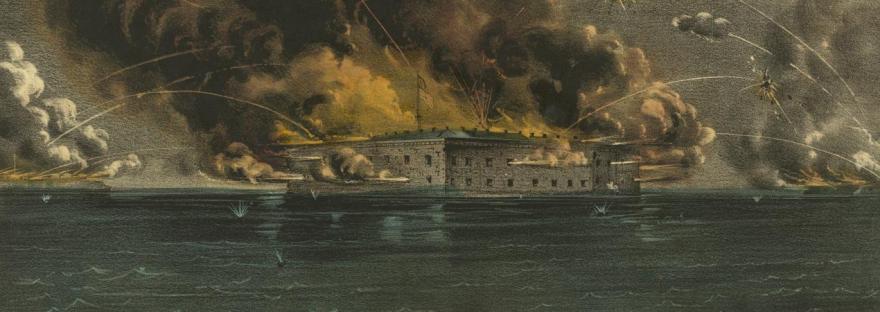
The events in Fort Sumter were riveting. A commander bound by duty, loyal to his country, but sympathetic to the Southern cause was essentially the last barrier between confrontation. Left at Fort Sumter to hold down the fort (no pun intended) of American military presence in the South with essentially no direction and no help until it was too late. I genuinely felt bad for Major Anderson. I think he made the best of an awful situation. And the Rebels saw him as this heroic villain.
In my opinion, an area improvement could have been the back history of some of the main figures. We learned a lot about the Southern planters and their racism, high-and-mighty sense of self-worth, and how they took their Southern honor seriously. To me, it felt like they were being made into a sort of likable antagonist. I would have liked to see a little more about Lincoln, Seward, and maybe some other more extreme elements in the Republican Party that also pushed us into the Civil War—it takes two! There were also parts of the battle that could have been shortened or summed up to make that drama a bit more concise. Like, did we need to keep going back to Fox who was just hanging out in the channel because he didn’t have a boat with guns to escort them in? Seemed unnecessary and repetitive.
Overall, I think this book was well written and used an array of primary and secondary sources to make Larson’s point that political horror, or what I call a shitshow, led to what happened at Fort Sumter. Bad politics, miscommunication, men with big heads and big ambitions, racism, and extremism converged to plunge our country into the Civil War. We can only hope that we learn from this and prevent another Fort Sumter-like flashpoint.
Mr. Larson, you get 5 stars from me!
I’d like to offer my opinion on a few of the poor so-called reviews that start with, “I put it back as soon as he compares Fort Sumter to January 6, 2021…” or “Just another historian writing his slant on history and how the Civil War was all about slavery when it wasn’t.” To the former reviews—he never says that. He only mentions January 6 in the first few lines to show how history sometimes rhymes. He showed similarities in that the nation was deeply divided after the election of Abraham Lincoln. There was fear that the electoral count would be interrupted either by political means or by a mob of angry people (sound familiar?). Or the safety of the president-elect for his inauguration and what the message would be to try and keep the country together—this sounds all too recent. That was the comparison. And that was the only time it was mentioned. He happened to be writing this history as those events unfolded. I find these reviews, which are not reviews at all because they never actually read the content of the book, to be frivolous.
Additionally, there seem to be some folks who still cannot grasp the historical fact that the core issue of the Civil War was slavery. There is this element of our society, and I dare say it is probably southern folk, that think slavery has absolutely nothing to do with the fracturing of our republic at that time. Folks, it was. You can look no further than South Carolina’s Declaration of Secession. The word “slave” or some form of it is used twelve times. Then move on to Mississippi’s declaration. The first sentence of the second paragraph reads: “Our position is thoroughly identified with the institution of slavery—the greatest material interest of the world.” Go and look at the rest of the seceding states’ declarations. A common theme…slavery. To nail the point home, one cannot leave out Confederate Vice President Alexander Stephens’s “Cornerstone Speech” when he says how slavery “…was the immediate cause of the late rupture and present revolution.” So there you have it… these states broke away to cement slavery into their society.

 The Weekend Historian